Skin Hydration Tools: Corneometer vs. Hydratest
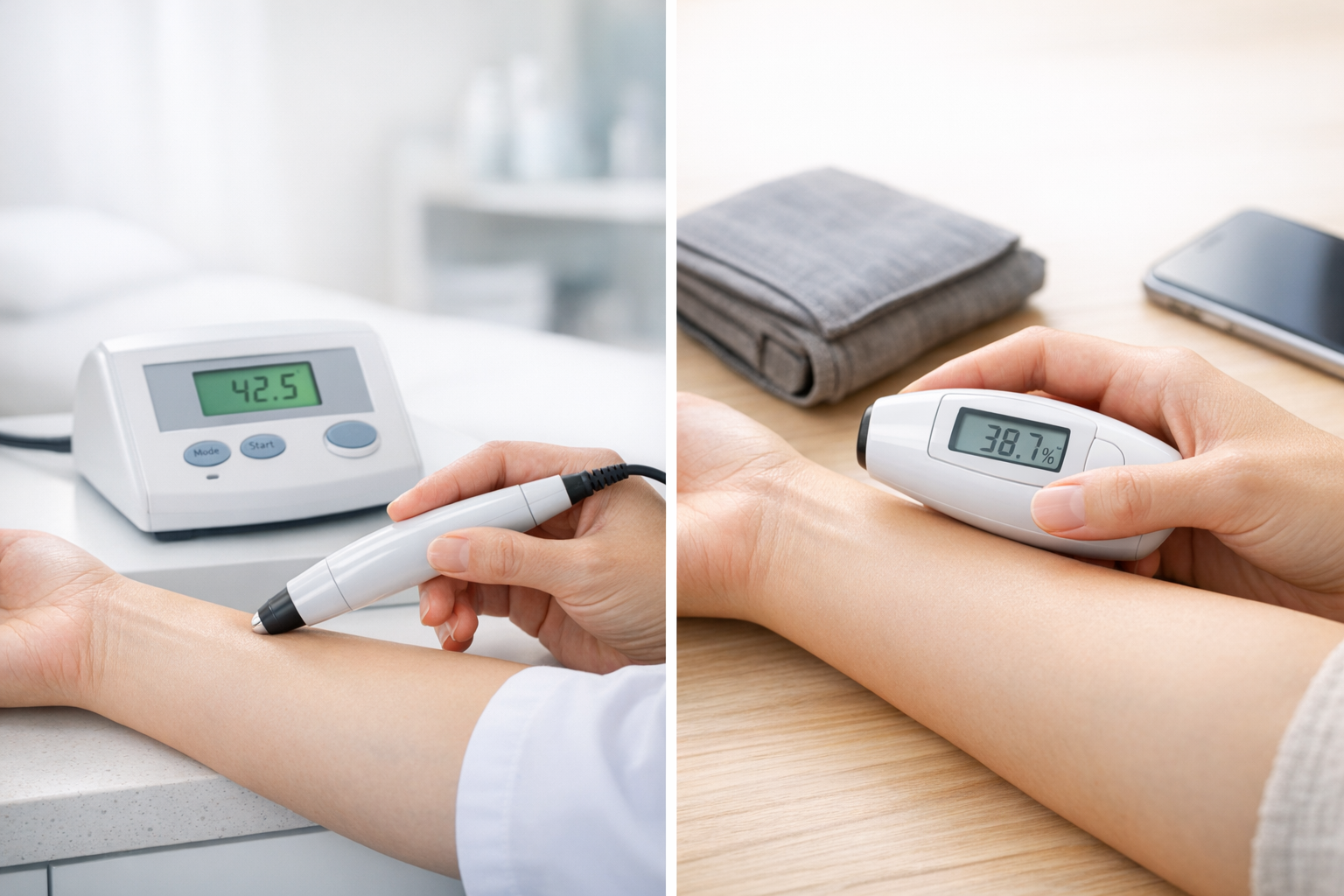
When it comes to measuring skin hydration, two popular tools stand out: the Corneometer and the Hydratest. Both devices use advanced technology to quantify moisture levels, but they differ in features, accuracy, and usability. Here's what you need to know:
- Corneometer: Known as the "gold standard" for hydration measurement, it uses capacitance technology to measure moisture in the upper layers of the skin (up to 45 µm). It’s highly precise, with minimal interference from skincare products, but comes with a higher price tag (£2,000–£5,000).
- Hydratest: A portable, budget-friendly option (£29.00) that uses Bioelectrical Impedance Analysis (BIA). It’s easy to use and measures hydration and oil levels, but is more affected by topical products and only measures the outer 15 µm of the skin.
Quick Comparison:
| Feature | Corneometer | Hydratest |
|---|---|---|
| Measurement Method | Capacitance | Bioelectrical Impedance |
| Measurement Depth | Up to 45 µm | Approx. 15 µm |
| Reading Time | ~1 second | 3–5 seconds |
| Price Range | £2,000–£5,000 | £29.00 |
| Product Interference | Minimal | Higher |
| Portability | Requires base station | Handheld, battery-powered |
The Corneometer is ideal for clinical research and precise tracking of hydration over time, a service offered by specialists like Skinology, while the Hydratest suits smaller clinics or mobile practitioners looking for a simple, affordable solution. Both tools can improve treatment outcomes when used properly, but selecting the right one depends on your clinic's needs and budget.
@figure 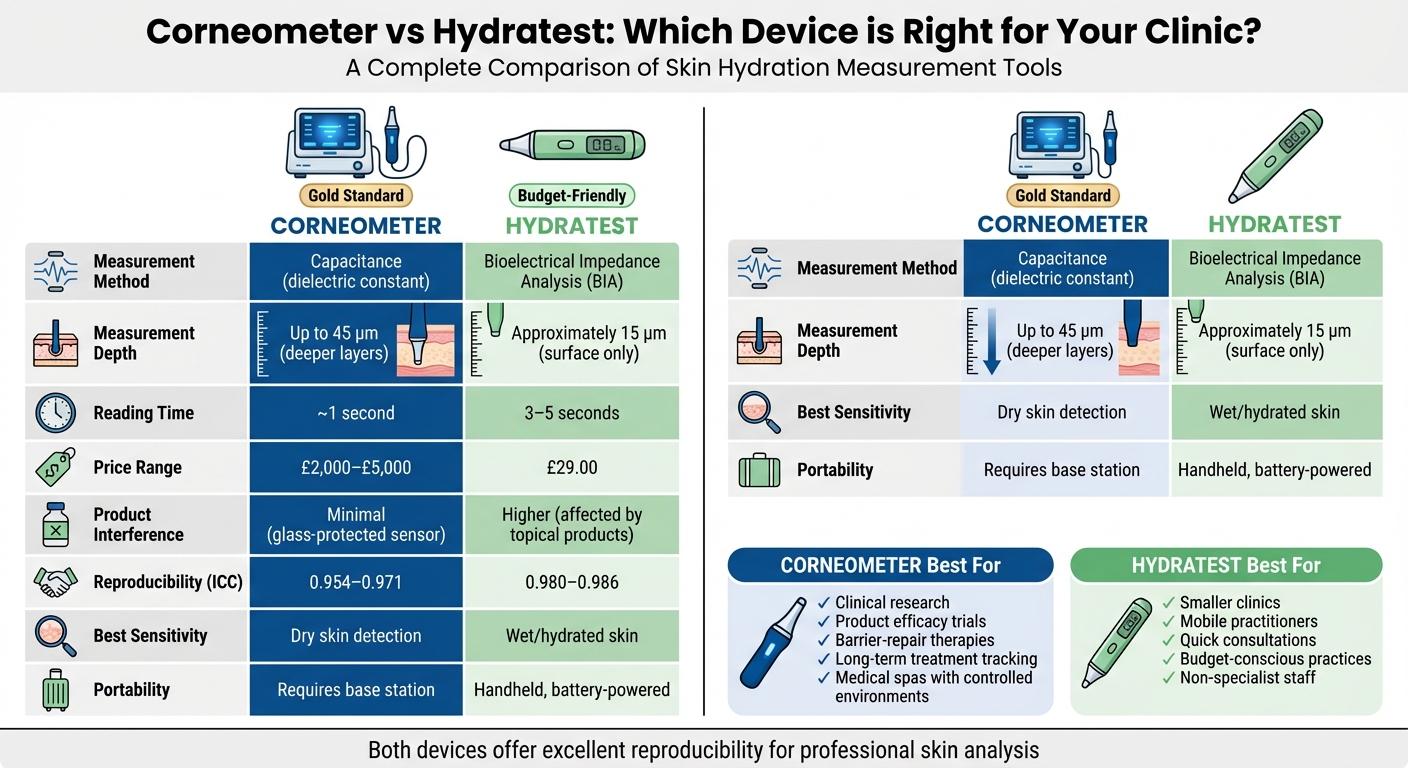 {Corneometer vs Hydratest: Complete Device Comparison for Skin Hydration Measurement}
Corneometer: Features and Benefits
Corneometer Features
The Corneometer uses advanced fringing field capacitance sensors to measure the skin's dielectric constant. This works because water, with a dielectric constant of about 80, contrasts sharply with most skin components, which have values below 7. This sensitivity allows the device to detect even minor changes in skin moisture. The probe is spring-loaded, applying a consistent pressure of approximately 1.0 N (±10%), ensuring accurate and repeatable results regardless of who operates it.
The device focuses on measuring only the upper 10–20 µm of the stratum corneum, avoiding interference from deeper layers like blood vessels. A thin glass lamina between the gold tracks and the skin prevents polarisation effects, ensuring only capacitance changes are measured. Plus, its 1-second reading time reduces the risk of occlusion effects.
"The Corneometer® is the world's best selling hydration measurement device to which other hydration instrumentation is always assessed and compared." – Enviroderm Services
The Corneometer provides results on a scale from 0 to 120 arbitrary units (AU), where skin is classified as very dry below 30 AU, dry between 30 and 40 AU, and normal above 40 AU. With a measurement uncertainty of ±3% and a lightweight, compact design (41 g with a 49 mm² measurement surface), it is versatile enough to measure hydration on various body areas, including sensitive spots like the lips. These features make it a reliable tool for clinical use.
Using the Corneometer in Clinics
Thanks to its technical capabilities, the Corneometer offers clear advantages in clinical settings. Its rapid 1-second measurement is ideal for busy clinics in Edinburgh, allowing for quick readings while minimising skin occlusion. Unlike conductance-based devices, the Corneometer's capacitance method is largely unaffected by salts, avoiding the exaggerated readings that other instruments might produce.
Endorsed by EEMCO guidelines and validated under extreme conditions, such as during use aboard the International Space Station, the Corneometer has proven its dependability in diverse environments. Maintenance is straightforward since calibration data is stored directly in the probe. A simple cleaning after use is usually enough to maintain accuracy.
Clinics should ensure patients acclimatise to the room's conditions before testing and wait at least 30 minutes after moisturiser application to achieve reliable results.
sbb-itb-349970b
Hydratest: Features and Benefits
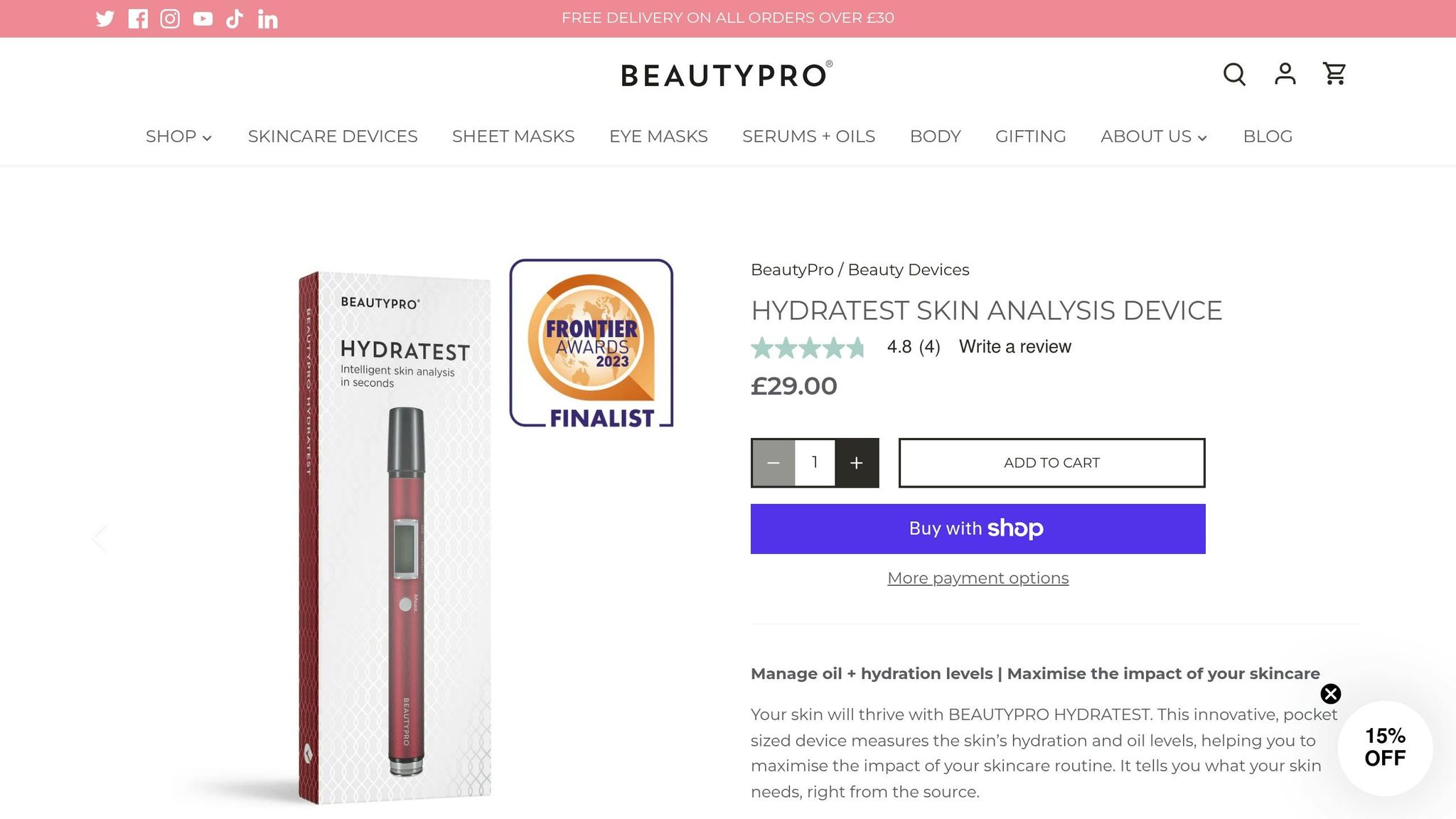
Hydratest Features
The Hydratest employs Bioelectrical Impedance Analysis (BIA) to measure hydration and oil levels in just 3–5 seconds. Results are displayed on a digital LCD screen, showing hydration as a percentage and oil levels on a scale of 1 to 5.
"This device uses Bioelectrical Impedance Analysis - the same credible technology used in routine medical and beauty equipment to ensure a precise reading about your skin." – BeautyPro
Its sleek, pen-like design, complete with a protective cap, ensures easy use across different areas, including sensitive zones like the face and lips. Powered by a single AAA battery, it supports approximately 1,000 measurements and comes with a 12-month manufacturing warranty.
Understanding results is simple: hydration levels below 31% indicate dehydration, while normal levels generally fall between 37% and 41%. For added guidance, the included Analysis Guide helps clinicians interpret readings and recommend suitable treatments. For example, low hydration levels might call for Hyaluronic Acid, while high oil levels could suggest Squalane.
These user-friendly features make it a practical tool for seamless integration into clinical workflows.
Using the Hydratest in Clinics
Thanks to its intuitive design, the Hydratest is a perfect fit for busy clinical environments. Its one-button operation makes it easy to use: simply turn it on, wait for the self-test to complete (indicated by a beep), and it’s ready to go. The quick reading time allows aestheticians to gather precise data during consultations, going beyond visual inspections to detect dehydration that might not be immediately visible, such as skin lacking flakiness.
"Having this tool at my disposal means I am now able to take better care of my skin... the data really gives me an insight into my skin's health." – DB Reviews
Priced at £29.00, the Hydratest provides an affordable way to measure both hydration and oil levels. It complements traditional skin analysis methods, offering an objective perspective. To ensure consistent accuracy, the sensors should be cleaned with a dry tissue after each use - avoid using alcohol or liquids.
Clinicians can also keep a record of client readings over time, tracking how skin responds to treatments or seasonal changes. This data helps tailor product recommendations to individual needs, improving consultation quality and overall treatment outcomes.
Corneometer vs. Hydratest Comparison
Comparison Table
The Corneometer and Hydratest are both highly reproducible but rely on distinct measurement methods. The Corneometer uses a glass-covered sensor to measure capacitance at depths up to 45 µm, whereas the Hydratest utilises Bioelectrical Impedance Analysis, focusing on the outermost 15 µm of the skin. In a 2024 clinical trial involving 184 participants, the Corneometer (CM820) achieved an Intraclass Correlation Coefficient (ICC) of 0.954–0.971, while the Hydratest recorded an ICC of 0.980–0.986 - both demonstrating excellent reliability.
| Feature | Corneometer | Hydratest |
|---|---|---|
| Measurement Principle | Capacitance (dielectric constant) | Bioelectrical Impedance Analysis |
| Measurement Depth | Up to 45 µm | Approximately 15 µm |
| Reading Time | ~1 second | 3–5 seconds |
| Product Interference | Minimal (glass-protected sensor) | Higher (affected by topical products) |
| Best Sensitivity | Dry skin detection | Wet/hydrated skin |
| Typical Price Range | £2,000–£5,000 | Cost-effective |
| Reproducibility (ICC) | 0.954–0.971 | 0.980–0.986 |
| Portability | Requires base station | Handheld, battery-powered |
The table highlights the main distinctions between the two devices, which are explored further below.
Strengths and Limitations
The Corneometer is often referred to as the "gold standard" for accuracy in clinical settings. Its glass barrier minimises interference from skincare products like moisturisers or serums. For example, conductance methods can show hydration increases as high as 505% when electrolytes are present, while capacitance methods (like the Corneometer’s) typically show a minimal variation of just 1.8%. This precision makes it a preferred choice for research and for tracking treatment outcomes in medical spas. However, to ensure reliable results, the testing environment must be controlled - patients need to rest for 30 minutes in a room kept at 20°C–22°C with 45%–55% humidity.
"The accuracy of other hydration measurement instrumentation on the market is always assessed against the standard of the Corneometer®." – Courage + Khazaka electronic GmbH
On the other hand, the Hydratest offers portability and affordability, making it a practical option for busy clinics. Its simple design, featuring one-button operation and instant digital readouts, is particularly user-friendly for non-specialist staff. However, it is more sensitive to surface products and electrolytes, which can affect its readings. For clinics looking for a more comprehensive view of skin hydration, using both devices together can provide a broader range of data by measuring at different skin depths.
These insights can help clinics choose the device that aligns best with their specific needs and workflows.
Recommendations for Scottish Aesthetic Clinics
Selecting the Right Device
Choosing between the Corneometer and Hydratest depends largely on your clinic's focus and operational needs. If your clinic specialises in barrier-repair therapies or clinical research, the Corneometer might be the better option. Its glass-protected sensor is less influenced by topical products, making it ideal for tracking results over multiple sessions - especially when testing moisturisers or serums. On the other hand, the Hydratest offers a lightweight, portable solution that suits smaller practices or mobile practitioners. Just note that patients need to avoid applying products for at least 30 minutes before using the Hydratest.
For consistent results, follow standardised testing protocols such as maintaining controlled environmental conditions and allowing for acclimatisation periods. It's recommended to take 3–5 consecutive measurements at each skin site and calculate the average to minimise variability. While the Corneometer measures deeper skin layers (up to 45 µm), the Hydratest focuses on more superficial readings, around 15 µm.
Once you've selected the right device, you can boost your clinic's reputation by showcasing your equipment on Scotland Aestheticians.
Using Scotland Aestheticians for Clinic Visibility

The data-driven results provided by tools like the Corneometer or Hydratest not only improve treatment outcomes but also build trust with your clients. Prominently displaying your use of advanced diagnostic equipment on Scotland Aestheticians (https://scotlandaestheticians.co.uk) can enhance your clinic's credibility. The platform offers verified listings and local SEO optimisation, helping clinics demonstrate their technical expertise and move beyond subjective visual assessments.
Clients can use the directory's search features to filter clinics by location and treatment type, making it easier for them to find practices offering advanced diagnostic services. Opting for a premium listing can further increase your clinic's visibility, as it prioritises your practice in search results. This is particularly advantageous for clinics that invest in high-quality equipment like the Corneometer, helping them stand out in the competitive Scottish aesthetic market.
Conclusion
Modern, data-driven hydration diagnostics have become essential for effective treatments and boosting the credibility of clinics. Devices like the Corneometer and the Hydratest offer reliable reproducibility, though they differ in their measurement principles. The Corneometer relies on capacitance with a glass-protected sensor, making it less prone to interference from topical products. In contrast, the Hydratest uses electrical conductance, which can be affected by salts and cosmetics.
For clinics conducting product efficacy trials or addressing dry skin conditions, the Corneometer stands out due to its ability to measure deeper (up to 45 µm) and its sensitivity to xerosis, making it a preferred choice. However, when using the Hydratest, it’s crucial to ensure that clients avoid applying any topical products for at least 30 minutes before testing to minimise interference. As Dr Ju Heon Park explains, "Using reliable and objective devices such as the Corneometer or HP aids in understanding skin condition and informs better care decisions".
The importance of consistent testing conditions cannot be overstated. Regardless of the device, following standard protocols - such as maintaining controlled temperatures, allowing acclimatisation, and taking consecutive readings - is essential. These practices not only validate treatment claims but also build trust with clients. By incorporating advanced diagnostic tools and adhering to strict protocols, clinics can improve treatment outcomes and strengthen their reputation in Scotland's highly competitive aesthetic market. Highlighting this expertise on platforms like Scotland Aestheticians (https://scotlandaestheticians.co.uk) through verified listings and local SEO efforts can further enhance credibility.
FAQs
To ensure accurate and consistent hydration readings, make sure the client’s skin is clean, dry, and free of any products, such as moisturisers or oils, as these can interfere with results. Avoid taking measurements after recent exposure to extreme temperatures or direct sunlight, as these conditions may skew the readings. The area being measured - typically the face or the relevant treatment site - should be accessible and free from makeup or lotions. Following these steps will help maintain reliable results.
To get accurate hydration measurements, it's important to minimise any interference from skincare products. Start by thoroughly cleansing the skin to remove any creams, oils, or serums. After cleansing, let the skin return to its natural state before taking measurements.
For consistent results, stick to a standard protocol: always measure the same area of skin, avoid applying products just before testing, and ensure the skin is at a stable temperature. These simple steps help ensure your hydration data is both reliable and consistent.
Maintaining a controlled room temperature and humidity is crucial for accurate skin hydration testing. These conditions help ensure consistent and reliable results by reducing the impact of environmental factors that could interfere with the measurements.