Your Complete Guide to a Semi Permanent Makeup Course
Thinking about a career in semi-permanent makeup? You're in the right place. This isn't just about learning a skill; it's about mastering an art form that blends creativity with precision. A semi-permanent makeup course is your first, most crucial step into this exciting industry, giving you the solid foundation in both theory and practical work you'll need to become a certified, insured, and trusted artist.
This guide is designed to be your no-nonsense roadmap. We'll help you navigate the UK's aesthetics world and find a course that genuinely prepares you for success.
Your Future in Semi-Permanent Makeup Starts Here
Let's cut through the noise and get straight to what it actually takes to build a reputation as a professional you can be proud of. Think of this as the honest chat you'd have with an industry veteran over a coffee before you commit your time, energy, and money to a new career.
The demand for talented SPMU artists is undeniable. The UK aesthetics industry is on a massive upward trend, predicted to be worth over £3.6 billion by 2025. To put that into perspective, 7.7 million people had an aesthetic treatment in 2023 alone. Drilling down, the permanent makeup market itself is expected to grow by a huge 12% every year between 2025 and 2033. The opportunity is real, but only for those with the right qualifications. You can find more insights on UK aesthetics industry growth if you want to dig into the numbers.
What to Expect From This Guide
We're going to cover all the bases so you can make a decision you feel good about. That means taking a close look at what a course actually teaches, why the right credentials matter so much, and what your next steps look like once you're certified.
Our goal is to give you the confidence to:
-
Understand Course Content: Know exactly what a top-tier programme must include, from deep-diving into colour theory to getting plenty of hands-on practice.
-
Navigate Legal Requirements: Make sense of the often-confusing world of accreditation, licensing, and insurance, with a special focus on how things work in Scotland.
-
Choose a Trusted Provider: Learn how to spot the reputable training academies from the ones that will leave you high and dry (and out of pocket).
-
Plan Your Career: Get a clear picture of the incredible business and employment paths that open up after you qualify.
By the time you've finished reading, you'll know how to find a semi-permanent makeup course that doesn't just teach you the techniques, but also protects you, your clients, and the future of your business. Let's get started.
What You Will Actually Learn in an SPMU Course
Signing up for a semi permanent makeup course is a serious commitment. It’s far more than watching a few videos online; it’s an intensive, hands-on experience designed to build a skilled artist from the ground up. The training is built on two crucial pillars: the foundational theory and the practical, hands-on skill.
Think of it like learning to be a master tailor. You first have to understand the fabric—its weight, weave, and how it drapes—before you can ever pick up the scissors to cut a perfect suit. This dual approach ensures you don't just graduate knowing how to do a procedure, but why you're doing it, allowing you to handle any client situation safely and confidently.
Mastering the Theory: The Science Behind the Art
Before you even think about picking up a machine, you’ll dive headfirst into the knowledge that separates a casual technician from a true professional. This isn't just about passing a test; it's the critical information that protects your clients, your reputation, and ensures beautiful, lasting results.
A huge chunk of your time will be spent on health, safety, and hygiene. This is non-negotiable. You’ll get rigorous training on bloodborne pathogens, infection control, and exactly how to create and maintain a sterile environment. It’s about knowing how to sanitise every piece of equipment and your entire workspace to prevent cross-contamination, a skill vital for client safety and legal compliance.
Then there’s skin anatomy. You’ll explore the different layers of the skin and, crucially, understand how things like age, ethnicity, and skin type (oily, dry, combination) completely change how pigment is accepted and how it heals. This is the secret to predicting what a treatment will look like months or even years down the road.
Understanding the skin is like a gardener knowing their soil. You can't expect beautiful results without first understanding the foundation you're working with. This knowledge dictates your needle choice, depth, and technique for every single client.
To give you a clearer picture, here’s a breakdown of the core modules you should expect to see in any high-quality course.
Core Modules in a Typical SPMU Course
Every great SPMU course is built on a solid foundation of essential modules. This table outlines what you can expect to learn, covering everything from client safety to the artistic skills needed to create stunning results.
| Module Category | Key Topics Covered | Learning Outcome |
|---|---|---|
| Health & Safety | Bloodborne pathogens, infection control, sterilisation, waste disposal, and workspace setup. | To perform treatments in a clinically clean, safe, and legally compliant environment, protecting both client and artist. |
| Skin Anatomy | Skin layers (epidermis, dermis), skin types, skin conditions, and contraindications. | To assess a client’s suitability for treatment and adapt techniques for predictable, long-lasting results. |
| Colour Theory | The Fitzpatrick Scale, skin undertones, pigment composition, colour correction, and avoiding undesirable healed colours. | To confidently select and mix pigments to create a perfect, custom match that heals true to colour. |
| Consultation & Design | Client communication, managing expectations, face mapping, pre-drawing techniques, and informed consent. | To design symmetrical, flattering enhancements and ensure the client is fully informed and happy before starting. |
| Practical Technique | Machine/tool handling, needle configurations, depth control, stretching techniques, and creating various effects (e.g., hair strokes, shading). | To develop the muscle memory and technical skill required to execute flawless SPMU procedures. |
Seeing these modules on a curriculum is a great sign that the provider is serious about producing competent, professional artists.
From Latex to Live Models: Building Your Practical Skills
Once you've got a solid grip on the theory, the training shifts to where the real magic happens: hands-on practice. This is where you build confidence and muscle memory, always under the watchful eye of an experienced trainer. The process is carefully structured, moving you forward only when you're ready.
You'll start your practical journey on latex skin. These silicone sheets are designed to mimic the feel of human skin, giving you a risk-free way to perfect your hand movements, pressure, and depth. You'll spend hours and hours on these, mastering the basics like creating crisp hair strokes for microblading or achieving that soft, pixelated effect for powder brows.
Only after you can show real skill and consistency on latex will you move on to live models. This is, without a doubt, the most important part of any reputable course. A good training academy will provide these models for you, creating a controlled, supportive environment for you to gain real-world experience. You’ll handle the entire process—from consultation and mapping to performing the full treatment—with your trainer right there to guide you. This is what truly prepares you to take on your very first paying client.
Understanding Accreditation, Licensing, and Insurance
Diving into the world of semi-permanent makeup courses can feel a bit overwhelming, especially when you start seeing terms like 'accreditation' and 'licensing'. But trust me, getting your head around this is the single most important thing you'll do. This isn't just about getting a certificate for your wall; it's about building the legal and professional foundation for your entire career.
Without the right credentials, you simply won't get insured, you’ll struggle to get a licence to practise, and you’ll be putting yourself and your clients at huge risk.
Think of it this way: anyone with a printer can create a fancy-looking "certificate of completion". But an accredited qualification is different. It’s like a degree from a proper university. It means an official, national body has scrutinised the course and confirmed it meets strict standards for quality, safety, and knowledge. It’s the difference between a piece of paper and a professional passport.
The Role of Accreditation Bodies
In the UK, accreditation is your stamp of quality. When a course is backed by a respected organisation like VTCT (Vocational Training Charitable Trust) or ABT (Associated Beauty Therapists), it tells you the curriculum has been thoroughly vetted. These bodies make sure the training covers everything from complex anatomy and skin theory to meticulous hygiene protocols.
This stamp of approval is exactly what insurers are looking for. If you try to get professional liability insurance with a non-accredited certificate, you'll almost certainly be turned away. For an insurer, it’s a massive red flag because there's no proof you've been taught to the required industry safety standards.
-
VTCT Qualifications: These are government-regulated qualifications sitting on the Ofqual framework. They are often seen as the gold standard in the beauty and aesthetics industry.
-
ABT Accreditation: Widely recognised and respected, ABT accreditation shows that a course meets high industry benchmarks for both its theoretical and practical elements.
Seeing one of these logos on a course prospectus isn't just a nice-to-have—it's your ticket to becoming a legitimate, insurable practitioner. If a training provider can't offer this, it's a clear sign to walk away.
Getting Licensed to Practise in Scotland
Once you've earned your accredited qualification, the next hurdle is getting a licence from your local council. In Scotland, it's a legal requirement for anyone performing skin-piercing treatments—which covers all forms of SPMU—to hold a specific licence for their premises. This is non-negotiable and is in place to protect public health.
The process usually involves an inspection from an environmental health officer. They'll visit your clinic or treatment room to ensure you're following strict hygiene and safety rules, including:
-
Sterilisation: You must show proof of proper sterilisation for any reusable equipment, typically using a device like an autoclave.
-
Waste Disposal: You need to have the correct procedures in place for disposing of clinical waste, especially sharps like needles.
-
Client Records: You must demonstrate that you maintain detailed, confidential health records for every client.
Without that accredited certificate, you'll find it very difficult to even start the application. Councils need to see that your training comes from a recognised, reputable source. It’s yet another example of how your choice of course directly impacts your ability to actually work in the field.
This flowchart shows how a properly structured course brings together the theory and practical skills needed to get you ready for these crucial steps.
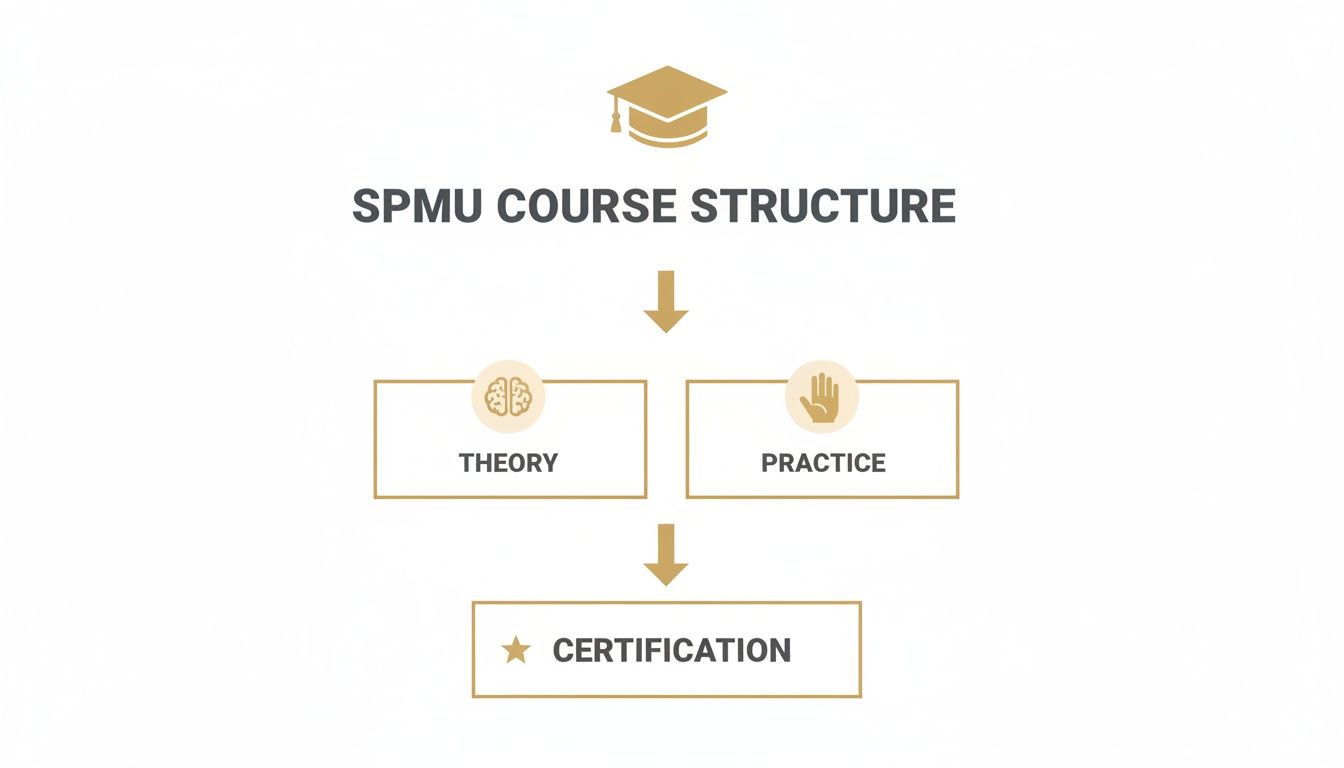
As you can see, a solid theoretical foundation is just as vital as hands-on practice. Both are essential for achieving professional certification and proving you’re ready to work safely.
A great course builds your skills progressively, ensuring you understand the 'why' behind the technique before you master the 'how'. This is the kind of robust structure that accreditation bodies and local councils want to see.
Why Insurance Is Non-Negotiable
Finally, let's talk insurance. Working without it is like driving a car without a seatbelt—you might get away with it for a while, but one small incident could be devastating for your business and personal finances. Professional treatment and public liability insurance is your safety net if something goes wrong.
This could be anything from a client having an allergic reaction to a pigment, an infection developing after the treatment, or even someone simply tripping over a piece of equipment in your clinic. Without insurance, you are personally liable for all the legal fees and compensation, which can easily run into thousands of pounds.
Reputable insurers will only offer cover to artists who can show proof of training from an accredited provider. It's their way of verifying that you're a low-risk professional who understands how to work safely. It’s the final, critical piece of the puzzle that lets you practise with confidence and complete peace of mind.
How to Choose the Right SPMU Training Provider
With so many semi-permanent makeup courses out there, picking the right one can feel a bit overwhelming. You see the glossy websites and the impressive before-and-afters, but how do you know which training provider will actually set you up for success? This isn't just about getting a certificate; it's the foundation of your entire career.
Think of choosing a provider like choosing a mentor. You don't just want a teacher; you want a seasoned pro who has been in the trenches and built a successful business themselves. A great trainer won't just read from a textbook—they’ll share the kind of real-world stories, troubleshooting tips, and business savvy that only comes from years of experience with actual clients.
Look Beyond the Classroom
The quality of any course really boils down to the person leading it. Before you even think about enrolling, do a little detective work on your potential trainer. Are they still a practicing artist? Do they have a busy clinic and a portfolio filled with beautiful, healed results? A trainer who is active in the industry brings a level of current, relevant knowledge to the classroom that is simply priceless.
Their hands-on experience creates a much richer learning environment. They can share anecdotes about tricky client situations, explain how to manage expectations, and give you practical advice on building a loyal client base—all the stuff you actually need to run a business.
A provider's commitment to you often shines brightest after the course ends. Do they offer a direct line for questions when you're stuck? Is there a graduate community group or the chance to come back for a shadow day? Ongoing support is the true sign of an academy that's invested in your career, not just your enrolment fee.
Class Size and Starter Kits
Two seemingly small details can tell you a lot about the quality of a course: the class size and the starter kit you receive. Both have a massive impact on how well you learn and how quickly you can start practising.
-
Small Class Sizes are Crucial: SPMU is a hands-on skill, and that means you need individual attention. Look for academies that keep their classes small, ideally with no more than four to six students per trainer. This makes all the difference, ensuring you get the one-on-one guidance you need to nail your technique and the space to ask questions without feeling rushed.
-
A Professional Starter Kit: Your kit shouldn't be an afterthought; it’s your first set of professional tools. A good one will include everything you need to start your case studies right away, from a reliable machine and quality pigments to a variety of needle cartridges. A cheap, unbranded kit is a huge red flag—if they're cutting corners there, where else are they cutting them?
Finding Trusted Local Experts
For anyone starting out in Scotland, finding a reputable local trainer in a city like Glasgow or Edinburgh is a huge advantage. They don’t just understand the market; they know the specific licensing requirements for Scottish councils. Training locally also helps you start building a professional network right on your doorstep.
A great way to see what top-tier local training looks like is to explore verified profiles of established providers. For instance, checking out a Glasgow-based beauty and aesthetics training academy can give you a clear benchmark for quality.
Ultimately, choosing the right course is an investment in yourself. By doing your homework on the trainer, insisting on small classes, and ensuring you get a professional-grade kit and proper support, you're making a choice that will empower you to build a safe, successful, and incredibly rewarding career.
Your Career Path After Gaining Your Qualification

Holding that accredited certificate in your hand is a fantastic feeling, but it’s really just the first step. Think of your qualification as a passport to a whole world of exciting and profitable career opportunities within the aesthetics industry. What you do next is entirely up to you, whether you fancy the freedom of freelancing or have big dreams of building your own brand from the ground up.
A popular first move for many newly qualified artists is to rent a room or a chair in an established beauty or hair salon. It's a brilliant way to dip your toe in the water. You get an instant, professional place to work and the chance to tap into the salon's existing customer base. This approach keeps your initial costs down, letting you focus on what really matters: perfecting your skills and building a killer portfolio.
Building Your Own Business
If you’ve got that entrepreneurial spark, the ultimate goal is often to open your own dedicated SPMU clinic. It’s a bigger leap, for sure—it takes more planning and investment—but the payoff can be huge. You’re the boss. You get to call the shots on everything from your clinic’s branding and the services you offer to your pricing and the entire client experience. It's your chance to build a space that’s a true reflection of your style and professional standards.
To get your own clinic off the ground, you’ll need to tackle a few key steps:
-
Securing Premises: Find a great spot that ticks all the boxes for your local council's licensing requirements.
-
Brand Development: Think about your name, logo, and how you'll look online. Make it memorable!
-
Marketing Strategy: Get the word out using social media, local ads, and a professional website to bring in your ideal clients.
-
Business Management: Get organised with your bookings, finances, and client records.
The freedom of running your own clinic is genuinely empowering. You get to build a business that works for you, set your own hours, and see the financial rewards of your hard work and talent first-hand.
Specialising in Lucrative Niches
Once you've nailed the foundational techniques from your initial course, you can really boost your earning potential by finding a niche. Specialising in advanced treatments not only makes you stand out from the crowd but also lets you offer high-value services that clients are actively looking for.
Some of the most rewarding areas to specialise in include:
-
Medical Tattooing: This is such a fulfilling field. You could be performing areola restoration for breast cancer survivors or camouflaging scars. It requires extra, advanced training, but the ability to make a genuine difference in someone’s life is priceless.
-
Scalp Micropigmentation (SMP): A game-changer for hair loss in both men and women. SMP creates the illusion of tiny hair follicles, offering a fantastic non-surgical alternative to hair transplants.
-
Advanced Lip Techniques: Becoming an expert in tricky procedures like lip neutralisation for clients with darker natural lip tones, or mastering advanced contouring, can quickly make you the go-to artist in your area.
The demand for these specialised skills is growing fast. Take scalp micropigmentation—it's become one of the UK’s most sought-after hair loss solutions, with a huge 50% increase in demand over the last year alone. This clearly shows that clients are leaning towards non-surgical options, and they need skilled practitioners to provide them.
Becoming a Trainer
Fast forward a few years. You’ve got tons of hands-on experience and a thriving business. What's next? You could become an educator yourself. Sharing your expertise and passion with the next generation of SPMU artists is an incredibly rewarding path. To become a respected trainer, like the professionals you'll find on Scotland Aestheticians, such as Gail George Permanent Makeup and Aesthetics, you'll usually need an extra teaching qualification to go alongside your advanced SPMU skills. It’s a great way to diversify your income and leave your mark on the industry.
Breaking Down the Costs and Time Commitment
Let's talk numbers. When you're looking into semi-permanent makeup courses, the financial and time investment are usually the two biggest questions on your mind. Getting a clear picture of what's involved from the start is crucial for planning your next career move with confidence.
It's easy to see the course fee as just another expense, but that's the wrong way to look at it. This is a direct investment in your professional future. The skills you learn, the certificate you earn, and the high-quality kit you walk away with are the very assets that will generate your income for years to come. Think of the cost not as a barrier, but as your ticket into a highly skilled and profitable industry.
In the UK, you can expect a fully accredited, comprehensive course to range from £3,000 to £6,000. You'll undoubtedly come across cheap online courses for a few hundred pounds, but trust me, they're a false economy. These unaccredited programmes won't qualify you for the necessary insurance or a local authority licence, making the certificate essentially worthless when it comes to working professionally.
What Your Course Fees Should Cover
A reputable training provider will always be transparent about what your investment includes, so there are no nasty surprises down the line. That price tag isn't just for a few days in a classroom; it covers a complete package designed to get you client-ready from day one.
At a minimum, your fees should always cover:
-
A Professional Starter Kit: This isn't a toy. It needs to be a high-quality digital machine, a proper selection of professional-grade pigments, various needle cartridges, and all the consumables required for your first several treatments.
-
Comprehensive Training Materials: Expect detailed, in-depth manuals that cover everything from skin anatomy and health and safety to advanced colour theory.
-
Accreditation and Certification Fees: The cost of getting your qualification officially recognised by bodies like ABT or VTCT should be built into the price.
-
Live Model Provision: The academy must provide live models for your practical training days. This is an absolutely critical part of building real-world confidence and skill.
-
Ongoing Post-Course Support: What happens when you leave? Invaluable support comes from having access to trainers or a graduate community for advice when you start taking on your own clients.
It's an investment that truly pays off. The global permanent makeup market is projected to grow from £110.20 million in 2025 to a staggering £202.02 million by 2033. And with artist income in the sector jumping by 15% in the last year alone, high-quality training offers a very clear path to a strong financial return. If you're interested in the data, you can read more about the micropigmentation market's growth to see the opportunity for yourself.
Understanding the Time Commitment
The time you’ll need to dedicate goes far beyond those first few days of training. A proper semi-permanent makeup course demands a serious commitment, both during and after the initial sessions, to ensure you become a competent and confident artist.
Your initial training is like passing your driving test; it proves you know the rules and can handle the car. The real learning happens on the road, when you start working with real clients and building your case studies.
A typical timeline usually breaks down like this:
-
Initial In-Person Training: This is the intensive part, usually lasting between 3 to 5 full days. It’s where you'll cover all the theory and get crucial hands-on practice on latex skin and, most importantly, live models.
-
Post-Course Case Studies: After the initial training, you'll be required to complete a portfolio of your own work. This typically means 6 to 10 case studies. This period is where you really hone your craft, and it can take several weeks or even months to complete properly.
-
Final Assessment: Once your portfolio is submitted and gets the green light from your trainer, you’ll receive your full, official certification.
This structured approach ensures you don't just learn the techniques but actually master them before you start charging clients full price. For a clearer picture of different training pathways, you can explore the overview and pricing of various aesthetic qualifications to see how comprehensive programmes are structured.
Got Questions About SPMU Training? Let's Get Them Answered
It's completely normal to have a ton of questions when you're thinking about jumping into a new career. When it comes to a semi-permanent makeup course, I find that most people are wondering about the same things: the background you need, how much you can really earn, and some of the practical ins and outs of the training itself.
So, let's clear up some of those common queries. The goal here is to iron out any last-minute uncertainties you might have, so you can feel confident about what this career really looks like before you dive in.
Do I Need to Be a Beautician Already to Start an SPMU Course?
Absolutely not. While having some experience in the beauty world can give you a little head start, it's by no means a deal-breaker. A great training course is built to take you from zero to hero, assuming you know nothing when you walk in the door.
What really matters is a steady hand, a good eye for tiny details, and a real passion for making people feel fantastic. A proper academy will give you all the theory you need – everything from skin anatomy to the critical safety and hygiene protocols. This ensures you can work safely and professionally, no matter your starting point.
Your success won't be defined by your background, but by how dedicated you are to mastering the craft. A brilliant course gives you the tools; it's your commitment that builds the expertise.
How Much Can I Realistically Earn as an SPMU Artist in Scotland?
The earning potential is one of the biggest draws, and for good reason. What you earn will come down to your location, your skill level, and how well you get the word out about your services. When you're just starting out in Scotland, you'll likely be charging somewhere between £150 and £250 per treatment as you build your portfolio and make a name for yourself.
Once you’ve got some experience under your belt and a solid client list, especially in hubs like Glasgow or Edinburgh, it’s not unrealistic to be charging £350 to £500 or more for a procedure. Just think, completing only a few treatments a week can quickly add up to a very healthy income, making this a seriously rewarding career path.
What's the Real Difference Between Microblading and Machine SPMU?
This is a fantastic question and gets to the heart of the techniques. Microblading is a manual method. We use a small handheld tool to create tiny, precise incisions that look just like natural eyebrow hairs. It’s perfect for that ultra-realistic brow look, but it works best on certain skin types.
Digital machine SPMU, on the other hand, uses a cosmetic tattooing machine with a very fine needle. This method is incredibly versatile. It's what we use for creating soft 'powder' brows, crisp eyeliner, and beautiful lip blush treatments. Most of the best courses will teach you both, giving you a much wider skillset to offer your future clients.
How on Earth Do I Find Models for My Training?
Any training academy worth its salt will handle this for you. A key sign of a quality course is that they provide live models for the practical sessions. This is non-negotiable. It’s your chance to get that crucial hands-on experience in a safe, controlled setting with your trainer right there guiding you.
After you've qualified, it's your turn to build a portfolio. The tried-and-tested way to do this is by finding your own models. You can offer treatments to friends, family, or people you find on social media at a heavily discounted 'portfolio-building' price. It’s the perfect way to polish your skills while creating a stunning gallery of your work.
Ready to take the next step and find a trusted, verified aesthetic professional in your area? Explore Scotland Aestheticians to connect with top-rated clinics and artists across Scotland. Visit https://scotlandaestheticians.co.uk to start your search today.
Aesthetician related to Your Complete Guide to a Semi Permanent Makeup Course

Elite Beauty Training and Aesthetics
Elite Beauty Training and Aesthetics redefines training provider in Falkirk. A 5.0-star haven for skincare lovers seeking excellence.

Gail George Permanent Makeup and Aesthetics
Gail George Permanent Makeup and Aesthetics in Falkirk is known for refined skin care clinic treatments and a flawless reputation with 101+ happy clients.