7 Red Flags When Choosing a Beauty Clinic in Scotland

When booking a beauty treatment in Scotland, your safety should come first. Many clinics operate without proper qualifications or oversight, putting patients at risk of complications like infections or permanent damage. Here are seven warning signs to watch for:
- Unqualified Staff: Always verify credentials. Practitioners should be registered with Healthcare Improvement Scotland (HIS) and relevant medical bodies like the GMC or NMC. Avoid those who can't provide proof of training or insurance.
- High-Pressure Sales Tactics: Avoid clinics that push you to book immediately with "limited-time offers" or discounts. Rushed decisions often lead to regret.
- No Discussion of Risks: Clinics must inform you of potential complications and have protocols in place for emergencies. If they downplay risks, it's a red flag.
- Unrealistic Promises: Be cautious of guarantees for "perfect" results or heavily edited photos. Results vary based on individual factors.
- Suspicious Pricing: Extremely low prices often indicate unregulated practitioners or counterfeit products. Transparent pricing is key.
- Poor Hygiene Standards: Dirty or unprofessional settings increase the risk of infections. Clinics must meet strict cleanliness and safety standards.
- Rushed or Skipped Consultations: A proper consultation is essential to assess your suitability and ensure informed consent. Avoid clinics that skip this step or rush through it.
Bottom line: Always check if the clinic is registered with HIS and take the time to verify credentials. Don’t be swayed by low prices or flashy social media ads - your safety is worth more.
@figure 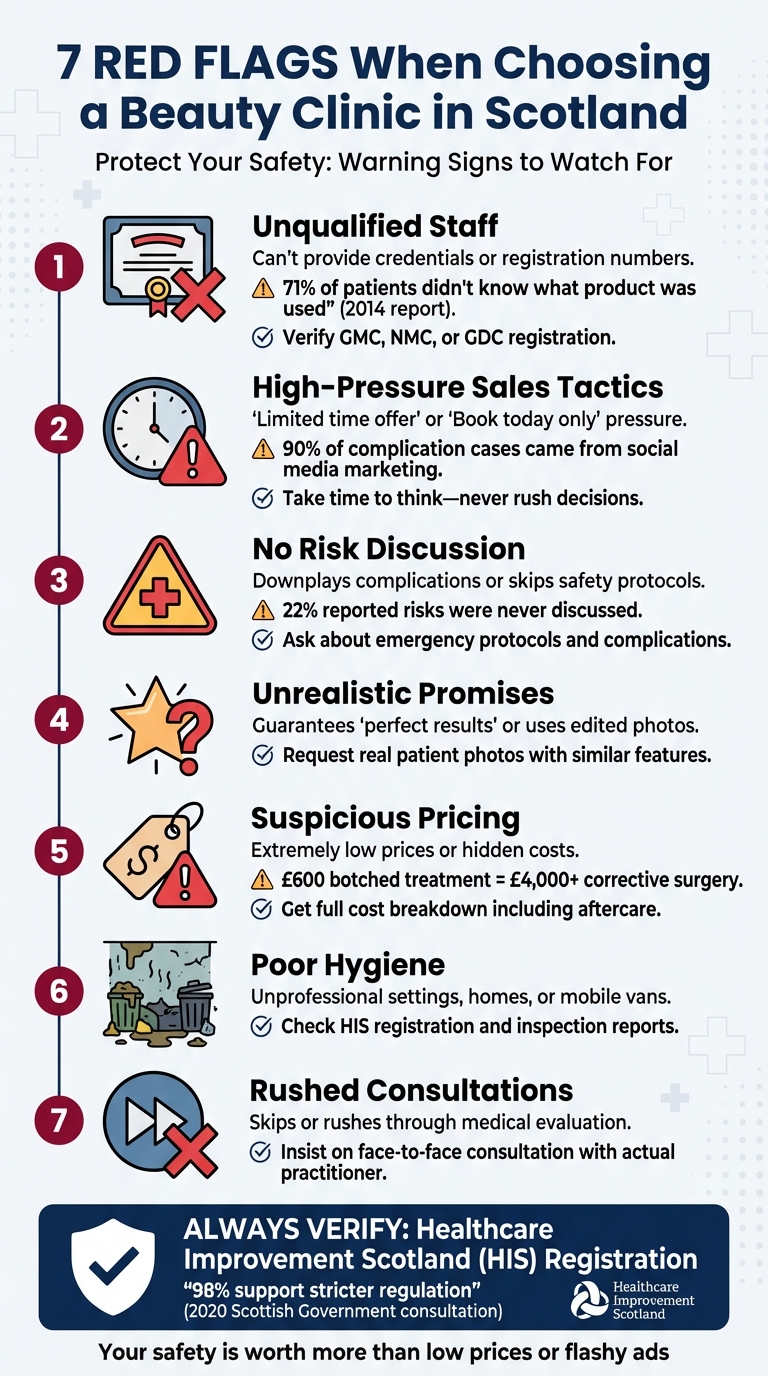 {7 Red Flags When Choosing a Beauty Clinic in Scotland}
1. Staff Lack Proper Qualifications or Won't Share Credentials
Staff Qualifications and Regulatory Compliance
If a practitioner hesitates to share their credentials or reacts defensively, it's a serious warning sign. In Scotland, clinics run by professionals like doctors, nurses, midwives, dental care specialists, or pharmacists are legally required to register with Healthcare Improvement Scotland (HIS). This registration ensures clinics maintain high standards, but unregulated operations still exist.
Before booking a procedure, check if the clinic is listed on the HIS register and review its latest inspection report, which rates quality from "unsatisfactory" to "exceptional". You should also confirm the practitioner's individual registration with the appropriate governing body, such as the General Medical Council (GMC), Nursing and Midwifery Council (NMC), or General Dental Council (GDC). If they refuse to share their registration number, it's a clear sign to look elsewhere.
Transparency about qualifications is essential, as it demonstrates a practitioner's ability to handle potential complications like infections, blocked arteries, or even blindness. Alarmingly, a 2014 report revealed that 71% of people receiving anti-wrinkle injections didn’t know what product was used. This lack of openness could indicate the use of unlicensed or counterfeit products, especially with prescription-only treatments like Botox.
"The basic qualification to become an 'injector' is a brief, one-day course. It is therefore essential to understand what the depth of training is and the level of experience your injector possesses." – Dr. Andrew Kane
When choosing a practitioner, ask about their training. Avoid those who’ve only completed a weekend "foundation" course. Instead, look for Level 7 qualifications in Aesthetic Medicine, which is a postgraduate certificate equivalent to university-level education. For laser treatments, ensure staff have completed Core 2000 safety training. Additionally, practitioners should be able to provide proof of comprehensive training and current professional medical indemnity insurance. If they can't, it's best to walk away.
Taking the time to verify qualifications not only ensures safety but also lays the groundwork for spotting other warning signs when selecting a trustworthy clinic.
2. You're Pressured to Book Treatments on the Spot
Transparency in Risks, Pricing, and Expectations
A trustworthy clinic will never push you into making an immediate decision. If you hear phrases like "this price is only available today" or "limited time offer", consider it a serious warning sign. These tactics create unnecessary pressure, depriving you of the time needed to think things through. They may also violate UK advertising regulations. Such high-pressure environments often lead to rushed consultations that lack proper care.
Shockingly, 22% of patients reported that safety and side effects were never discussed before their treatment. Even more concerning, 90% of those who experienced complications had chosen their practitioner based on aggressive social media marketing. Acting on impulse in these situations can lead to severe outcomes, including skin necrosis, permanent blindness, or burns.
Thorough Consultation and Patient Care
High-pressure tactics can undermine the very foundation of informed consent. Eddie Docherty, Director of Quality Assurance and Regulation at Healthcare Improvement Scotland, highlights how these environments can cloud judgement:
"Having a cosmetic treatment is a serious undertaking that should only be entered into with due consideration of the very real risks to an individual's health and safety. Bringing together the injecting of Botox, alcohol and a party atmosphere reduces people's judgement, and their ability to properly provide consent and consider the real risks."
Before committing to any treatment, ensure you have a detailed consultation with the practitioner who will actually perform the procedure. Use this opportunity to ask about their approach to handling complications. If they seem evasive or demand payment upfront before the consultation, it's a clear sign to look elsewhere. Reliable clinics understand that these treatments require careful thought and should never be rushed. Keep in mind that fixing a poorly performed procedure can be incredibly costly - correcting a £600 treatment gone wrong could result in surgery expenses of at least £4,000.
3. The Clinic Avoids Discussing Risks and Complications
Transparency in Risks, Pricing, and Expectations
When it comes to aesthetic procedures, honesty about risks and complications is non-negotiable. Clinics that avoid discussing potential problems undermine your ability to make an informed decision. Even non-surgical treatments like dermal fillers come with serious risks, such as infection, nerve damage, or, in rare cases, blindness. If a practitioner dismisses these risks or treats prescription-only medications like Botox as casual beauty fixes, they are ignoring the medical seriousness of these treatments. Be cautious of vague promises like "pain-free results" that fail to mention possible complications.
A critical warning sign is when a practitioner cannot clearly explain what they would do if something goes wrong. Don’t hesitate to ask: “What are the most common complications of this procedure, and how many times have you personally dealt with one?”. If their response is evasive or unclear, it’s a signal to look for another provider. For instance, dermal fillers can block arteries, potentially causing blindness or stroke, and require emergency protocols and reversal agents like hyaluronidase to manage.
Thorough Consultation and Patient Care
Discussing risks isn’t just a formality - it’s a critical part of ensuring patient safety. Reputable clinics prioritise thorough consultations as part of their commitment to transparency and informed consent. A 2020 Scottish Government consultation revealed that 98% of respondents supported stricter regulation of the aesthetics industry, reflecting widespread concerns about safety. This concern is well-founded, as complaints about procedures like non-surgical breast enhancements and Brazilian Butt Lifts in the UK surged from fewer than five to 50 within a single year.
A proper consultation should comprehensively cover all risks and leave no questions unanswered. If a clinic skips this step or rushes through it, they’re compromising your safety. Additionally, in the UK, Botox - a prescription-only medicine - legally requires a consultation with a qualified prescriber before it can be administered. If a clinic tries to bypass this, it’s a red flag.
In Scotland, make sure the clinic is registered with Healthcare Improvement Scotland (HIS). Registered clinics are held to strict safety standards and undergo regular inspections. Natalie Graham, Administrative Officer at Healthcare Improvement Scotland, highlights the importance of this regulation:
"I felt that not only was I given great advice about what would work for me specifically, but that the clinicians wanted to make sure that I was getting the procedures for the right reasons... This was very different from the non-regulated clinics."
4. They Make Unrealistic Promises About Results
Transparency in Risks, Pricing, and Expectations
If a practitioner promises 'perfect' results or guarantees no side effects, it's a sign to look elsewhere. Treatments like Botox and dermal fillers produce results that vary greatly depending on factors like your bone structure, skin quality, and age. Clinics making sweeping assurances may be focusing on profits rather than your wellbeing. Dr. Rupert Critchley, Director and Founder of VIVA Skin Clinics, explains:
"Striving for perfection can lead to more treatment, an unnatural finish and a continuous cycle of dissatisfaction."
Be cautious of stock images or manipulated photos. Some clinics use digitally altered "before and after" shots or images with inconsistent lighting [11, 12]. In the UK, it's against Advertising Standards Authority (ASA) guidelines to display before-and-after images for Botox, as it is a prescription-only medication. Instead, ask for results from patients with similar skin types and confirm when the after photos were taken. If a clinic relies on heavily filtered social media pictures or can't back up their claims, it’s a major warning sign. This kind of misrepresentation erodes the trust that should be central to consultations.
Thorough Consultation and Patient Care
Setting realistic expectations begins with a detailed consultation. A trustworthy practitioner will explain both the potential results and the limitations of the treatment, including how long the effects last - Botox, for instance, often wears off after a few months [7, 12]. Dr. Critchley highlights:
"It's important for every client to understand that, as practitioners, we still want them to look like themselves."
Be wary of practitioners who agree to extreme or unnatural enhancements without considering a balanced approach. This could suggest they prioritise financial gain over your safety. During your consultation, ask direct questions like, "What can I expect to look like?" and "What are the limitations of this treatment for someone with my features?". If the answers sound overly optimistic or unrealistic, it’s worth reconsidering your choice. Honest, transparent consultations are essential for setting achievable expectations and ensuring your safety.
5. Pricing Is Suspiciously Low or Unclear
Transparency in Risks, Pricing, and Expectations
When it comes to cosmetic treatments, suspiciously low pricing can often signal trouble. If an offer feels too good to be true, it probably is. Take, for instance, a £600 'Botox' treatment administered in an unregulated home setting. The result? Skin discolouration and lumps that required corrective surgery costing upwards of £4,000.
Unclear pricing is another red flag. It often hides additional charges for follow-ups and aftercare. To avoid surprises, always ask for a full breakdown of costs, including the consultation, procedure, and any necessary aftercare appointments. Be cautious of clinics that push "limited time offers" or demand payment before conducting a proper medical assessment. These tactics are designed to pressure you into a decision - one you may regret later.
Natalie Graham, Administrative Officer at Healthcare Improvement Scotland, puts it plainly:
"While the price might seem lower, the quality of care may be worse as well. Should there be a medical emergency, many of the clinics that are not registered may not be able to help."
These pricing strategies often point to more profound issues, such as inadequate practitioner oversight.
Staff Qualifications and Regulatory Compliance
Low prices frequently go hand in hand with unqualified practitioners. In some cases, procedures are carried out by individuals like beauticians or tradespeople who lack medical training and oversight. Dr. Nestor Demosthenous, a spokesperson for the British College of Aesthetic Medicine, highlights the alarming reality:
"It is currently completely legal for a plumber or a hairdresser to inject a 16-year-old girl in the back of a van with no recourse."
Another concern is the use of counterfeit or unlicensed products sourced online, rather than from trusted medical suppliers. These practitioners are often untrained in handling complications, such as administering hyaluronidase to dissolve fillers that block blood vessels - a situation that can lead to severe consequences like tissue death, blindness, or even stroke. Always confirm that the clinic is registered with Healthcare Improvement Scotland (HIS).
Professionalism and Hygiene Standards
Transparent pricing is only part of the equation. Adherence to clinical standards and proper hygiene is equally critical. Clinics offering rock-bottom prices often operate in unsuitable locations like private homes, hotels, or mobile vans - none of which meet HIS standards. These makeshift setups typically lack proper infection control measures and emergency equipment.
Be especially wary of "Botox parties", social media vouchers, or group discount bundles. Shockingly, nearly 90% of individuals who reported complications from cosmetic treatments found their practitioner through social media. Always verify that the products being used are sourced from a licensed pharmacy and check the brand. If a clinic refuses to provide this information or reacts defensively, it’s a clear warning sign.
6. The Clinic Looks Dirty or Unprofessional
Professionalism and Hygiene Standards
When you walk into a clinic, its cleanliness - or lack thereof - speaks volumes. A messy, disorganised treatment area isn't just an eyesore; it can pose serious risks, including infections, poorly executed procedures, and other complications. A well-run clinic should use sterilised equipment, single-use tools, proper waste disposal methods, and ensure staff wear appropriate personal protective equipment (PPE). A dirty or chaotic workspace often leads to subpar results and, more worryingly, puts your health at risk.
Dr. Andrew Kane, Founder of Dr. Kane Aesthetics Co., highlights the importance of hygiene:
"This lack of professionalism and hygiene creates serious risks for patients... Anything less puts you at greater risk of botched procedures, poor results, and potentially serious complications."
Be wary of clinics offering treatments in non-clinical settings, such as homes or pop-up locations. These environments often lack the sterile conditions needed for safe procedures, increasing the risk of cross-contamination and exposure to blood-borne viruses. In Scotland, for example, clinics registered with Healthcare Improvement Scotland (HIS) must adhere to strict rules, such as banning pets (except service animals) from treatment areas and prohibiting alcohol consumption by patients during procedures. Spotting either of these is a clear red flag. Always verify that the clinic is HIS-registered to ensure it meets essential safety and cleanliness standards.
Another warning sign is when clinics juggle multiple patients at once. This can dilute the attention and care you receive, potentially leading to errors. Natalie Graham, Administrative Officer at Healthcare Improvement Scotland, shared her experience:
"Frequently, they would have more than one patient in at the same time, which meant I didn't receive their undivided attention, which naturally increased the scope for error."
Before committing to a clinic, check its registration with Healthcare Improvement Scotland and review their latest inspection report on the HIS website. HIS assigns ratings ranging from Exceptional to Unsatisfactory, so you can avoid unsafe environments. As Natalie Graham emphasises:
"Now the most important factor in my decision-making is whether the clinic is registered with us."
7. Consultations Are Rushed or Skipped Entirely
The Importance of a Proper Consultation
A consultation is more than just a formality - it's a detailed medical evaluation that ensures your treatment is safe and suitable for you. When clinics rush through this process or skip it altogether, they're putting your health at risk. This step must be carried out by the qualified professional who will actually perform your treatment. As Dr. Andrew Kane, Owner of Dr. Kane Aesthetics Co., puts it:
"A consultation is needed to determine your goals, expectations, and even your suitability for treatment. Unfortunately, some clinics operate on extremely tight schedules, focusing on maximising profits rather than offering personalised care."
For treatments involving Prescription-Only Medicines (POMs), such as Botox, a face-to-face consultation with a qualified prescriber - whether a doctor, nurse, or pharmacist - is legally required in Scotland. It's crucial to meet the person who will carry out your procedure, rather than a patient coordinator who might lack the qualifications to assess your medical history or risks. Skipping or rushing this step can lead to overlooked contraindications, like allergies or underlying health issues.
Taking the time to reflect after your consultation is equally important. Avoid clinics that pressure you to book immediately or use tactics like "limited time" offers to rush your decision. As Illusion Laser Clinic advises:
"Reputable practitioners welcome questions and never rush decisions. If something feels wrong or you feel pressured, step away."
A thorough consultation should also outline who will handle your aftercare and what steps to follow if complications arise. Insist on a detailed, unhurried consultation - it’s a key part of ensuring your safety and peace of mind.
Safety in Beauty - How to safely choose an Aesthetics Clinic
Conclusion
Selecting a beauty clinic in Scotland goes well beyond hunting for the lowest price or the nearest location - it’s about safeguarding your health and wellbeing. Warning signs like unqualified staff, pushy sales tactics, or rushed consultations can signal serious risks to your safety. The seven red flags we've discussed highlight the critical difference between clinics that focus on patient care and those that take shortcuts, potentially leading to issues like infections, disfigurement, or even medical emergencies requiring NHS assistance.
The risks are very real. For instance, there have been cases where complications necessitated corrective surgery. Many of these issues have been traced back to practitioners found through social media, with complaints about non-surgical procedures skyrocketing - from fewer than five to 50 in a year for certain treatments. These figures stress the importance of verifying credentials and ensuring consultations are handled with care. Eddie Docherty, Director of Quality Assurance and Regulation at Healthcare Improvement Scotland, puts it plainly:
"Having a cosmetic treatment is a serious undertaking that should only be entered into with due consideration of the very real risks to an individual's health and safety".
Before booking any treatment, always check if the clinic is registered with Healthcare Improvement Scotland (HIS). This step confirms that the clinic has been inspected, complies with legal requirements, and employs qualified staff. As Natalie Graham, Administrative Officer at Healthcare Improvement Scotland, explains:
"Now the most important factor in my decision-making is whether the clinic is registered with us. This means that their staff will be appropriately qualified and the clinic inspected and their reports published online".
Scotland Aestheticians is here to help you find clinics that meet these professional standards. Our directory connects you with registered practitioners who prioritise safety, clear communication, and proper medical practices, empowering you to make well-informed choices. Avoid being swayed by low prices or flashy social media offers.
Take the time to ask questions, verify credentials, and insist on a detailed consultation - your safety should always come first. By recognising these warning signs, you can ensure your decisions are grounded in professionalism and care.
FAQs
To check if a clinic is registered with Healthcare Improvement Scotland, head to their official registry or browse their inspection reports. These tools help confirm the clinic's registration status and adherence to required standards, giving you peace of mind that you're selecting a regulated and safe provider for your treatments.
When attending a consultation, it's important to ask about the practitioner's qualifications and experience to ensure they are properly trained for the procedure. Take a moment to review the clinic's safety and hygiene standards, and make sure you fully understand the treatment process, including any potential risks and the expected outcomes.
Be clear on the full cost, including any additional fees that might arise. Lastly, check whether the clinic is regulated by relevant authorities, such as Healthcare Improvement Scotland or other local licensing bodies, for added peace of mind.
If something goes wrong after a beauty treatment, it's important to act quickly. Start by seeking medical advice to address the issue. Reach out to the clinic or practitioner to report the problem and ask for any recommended aftercare.
For more serious complications, or if the clinic doesn't respond, consult a healthcare professional or NHS services for further assistance.
If you suspect negligence, collect evidence such as photos and receipts. You might also want to speak to a solicitor who specialises in cosmetic treatment claims to understand your legal options.